
Without dopamine, we wouldn’t feel driven and motivated. But what happens when dopamine stops being a means to an end and turns into an end in itself? Dopamine has been blamed for many destructive behaviors of our modern lifestyle, making “dopamine fasting” the newest Silicon Valley craze. Is an excess of this neurotransmitter turning us into insensitive pleasure junkies or is the science a bit more complicated? Read on!
What is Dopamine?
Definition
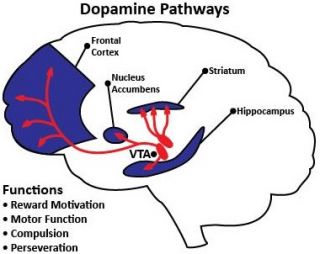
Dopamine is a neurotransmitter, a chemical released by neurons (nerve cells) to send signals to other nerve cells [1].
Many areas of the brain produce dopamine. It is produced in the ventral tegmental area (VTA in the image above) of the midbrain, the substantia nigra pars compacta, and the arcuate nucleus of the hypothalamus [2].
The most important dopamine pathway in the brain controls reward-motivated behavior [1].
Most types of rewards, such as new experiences or accomplishments, can increase dopamine levels in the brain. In addition, most addictive drugs and behavioral addictions can increase dopamine [3].
In addition, dopamine has many other important roles in humans, including movement, memory, attention, learning, sleep, and mood [2].
Dysfunctions of the dopamine system contribute to Parkinson’s disease, schizophrenia, restless legs syndrome, and attention-deficit hyperactivity disorder (ADHD) [1].
Schizophrenia is characterized by high striatum dopamine, but abnormally low prefrontal dopamine activity [4].
Genetics Behind Dopamine
See this post for a more comprehensive guide on the genetics of dopamine.
- Dopamine D1 Receptor gene (DRD1)
- Dopamine D2 Receptor gene (DRD2) [5]
- Dopamine D3 Receptor gene (DRD3)
- Dopamine D4 Receptor gene (DRD4) [6]
- Dopamine D5 Receptor gene (DRD5)
- Tyrosine Hydroxylase (TH)
- Dopamine beta-hydroxylase (DBH)
- Catechol-O-Methyltransferase (COMT)
- D-amino acid oxidase (DAO
